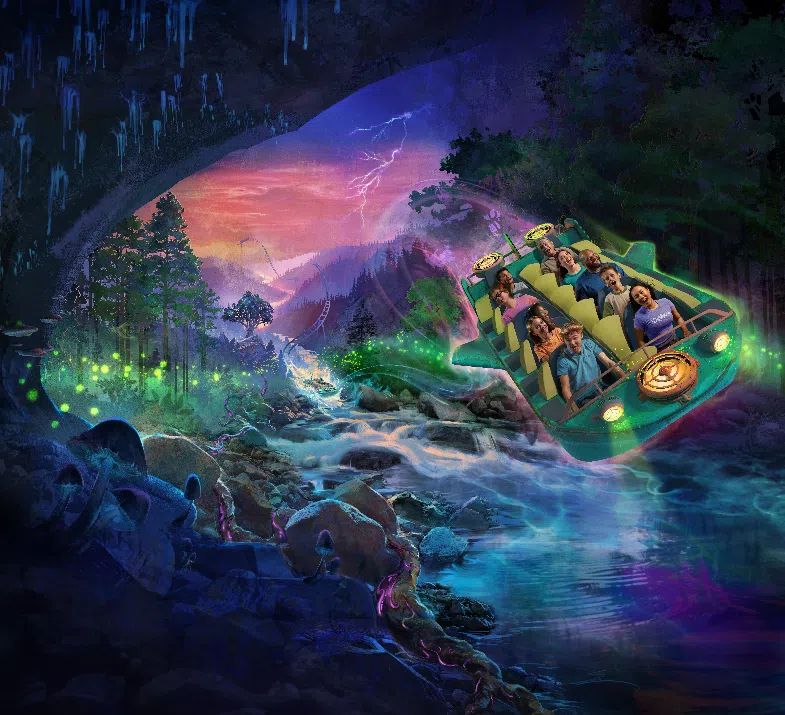
PIGEON FORGE, Tenn. (WOKI) — As students prepare to return to school and Dollywood readies for the August 19 debut of its highly anticipated NightFlight Expedition attraction, a new educational initiative is giving fifth-grade classrooms a chance to explore some of the Smokies’ most fascinating natural phenomena while competing to win a trip to the park.
Dollywood, Smokies Life and Discover Life in America have partnered to create Glow Life, a free science-focused program designed for fifth-grade students across East Tennessee and Western North Carolina. The initiative introduces students to bioluminescence and biofluorescence, natural processes featured prominently in the storyline of Dollywood’s newest attraction.
The program includes standards-based curriculum materials aligned with Tennessee and North Carolina science requirements, an educational video and a classroom contest designed to encourage scientific exploration and creativity.
Participating classrooms are invited to create and submit projects that demonstrate their understanding of bioluminescence and biofluorescence and their role in the Great Smoky Mountains ecosystem. Entries can take many forms, including essays, artwork, videos, songs, plays or even original concepts for new bioluminescent organisms.
Five winning classrooms will receive a class trip to Dollywood in spring 2027, where students will have the opportunity to ride NightFlight Expedition and connect their classroom learning to the attraction’s Smoky Mountain-inspired adventure.
Carol Agee, Dollywood’s Community Affairs and Philanthropy Manager, said the project reflects the park’s commitment to highlighting the region’s unique natural heritage.
“In everything we do at Dollywood, it is our goal to be authentic to this amazing place we call home,” Agee said. “Our newest attraction, NightFlight Expedition, allows us to introduce the fascinating story of bioluminescence found here in the Smokies.”
Agee said organizers hope the program will encourage scientific curiosity and a deeper appreciation for Great Smoky Mountains National Park.
Bioluminescence occurs when living organisms generate light through a chemical reaction. Biofluorescence, meanwhile, happens when organisms absorb ultraviolet or blue light and re-emit it as another color, often green, orange or red.
The Smokies provide a natural laboratory for both phenomena. Great Smoky Mountains National Park is considered the most biodiverse national park in the United States, with more than 22,000 species documented so far. Scientists estimate that between 60,000 and 80,000 species may ultimately be found within the park, leaving thousands still waiting to be discovered.
Todd Witcher, executive director of Discover Life in America, said many visitors know about the region’s synchronous fireflies, but Glow Life encourages students to look beyond one famous species.
“The Glow Life contest encourages scientific exploration beyond fireflies to an abundance of other bioluminescent and biofluorescent organisms, from mushrooms to salamanders,” Witcher said.
Smokies Life CEO Jacqueline Harp said the project supports efforts to inspire future scientists and environmental stewards.
“It is exciting to find new ways to ignite curiosity for the next generation of scientists and stewards of the Smokies through the Glow Life project,” Harp said.
Organizers also believe NightFlight Expedition will encourage visitors to further explore Great Smoky Mountains National Park, the nation’s most-visited national park.
The new indoor adventure coaster takes riders on a journey through the Smokies, soaring over mountain peaks, rushing rapids and shimmering lakes while searching for glowing plants and creatures hidden in the darkness.
Teachers interested in participating in the Glow Life contest or reviewing eligibility requirements can find more information at smokieslife.org/glowlife-landing-page. Additional information about Smokies Life is available at http://smokieslife.org, while Discover Life in America can be found at http://dlia.org.