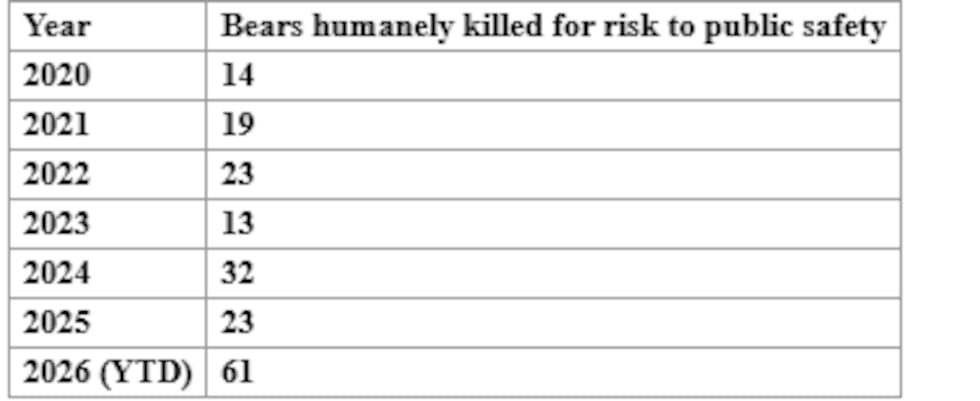
SEVIER CO., Tenn. (Story courtesy of WVLT) – After learning that 60 bears were humanely killed by the Tennessee Wildlife Resources Agency in Sevier County — with 61 statewide as of this year — WVLT requested data on bear deaths in relation to humans from the previous five years.
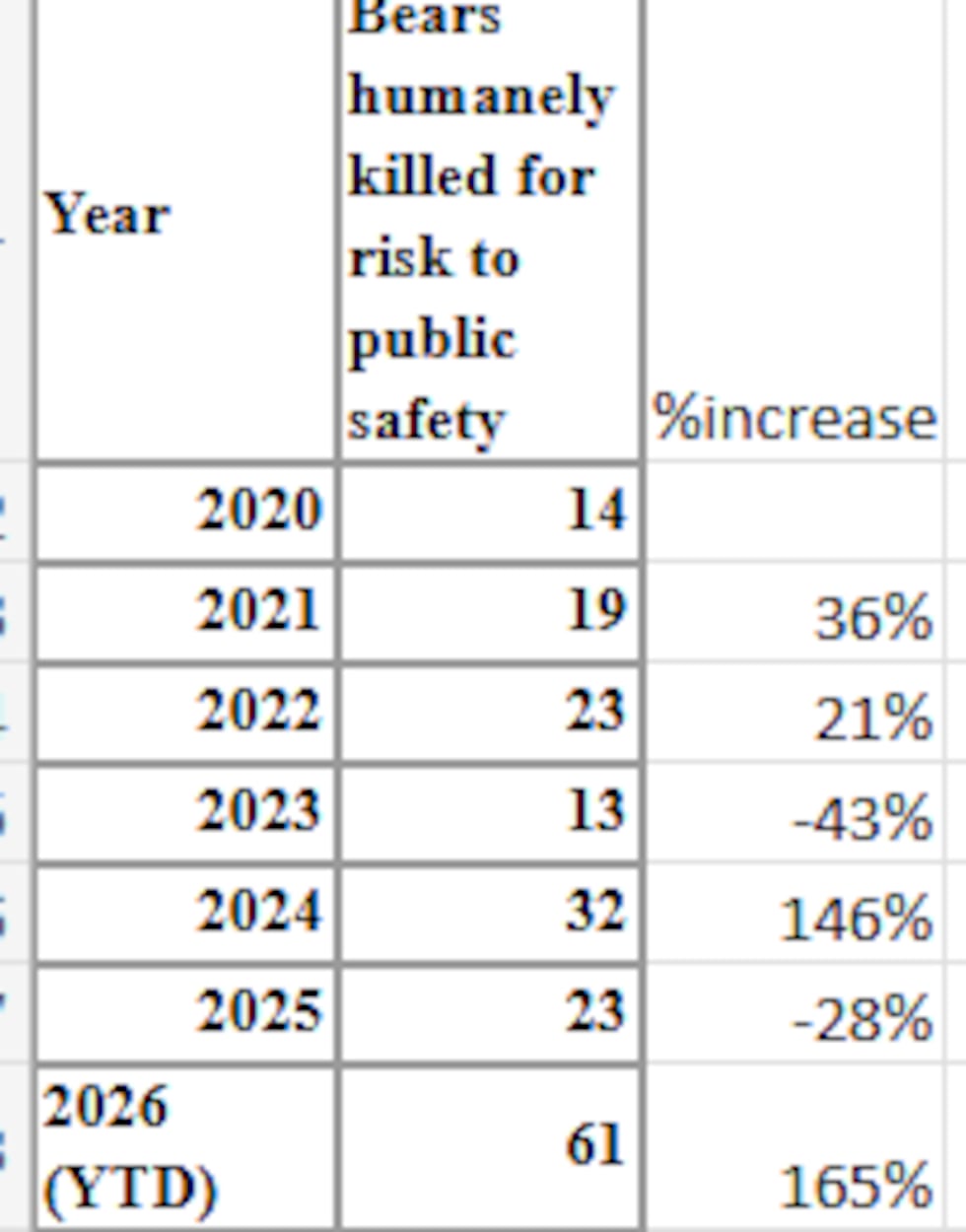
The chart below, provided by TWRA, represents data on bear deaths that resulted from human interaction within the last five years, noting a 165% increase and more than double deaths — just from 2025.
TWRA notes that human-bear conflict levels vary from year to year and can be due to a variety of factors.
Increases in hyperactive bear activity for 2026
Chelsey Sexton, TWRA’s Assistant Chief of Communications & Marketing, says that the agency saw an increase of bear activity from the past year.
“In 2026 we saw an increase of bears breaking windows and doors out of buildings and cars including with people in them. TWRA’s priority will always be public safety and bears that exhibit these behaviors are dangerous,” Sexton said.
Below is another perspective chart angle depicting the number of bear deaths due to human interactions within the last five years withy information from TWRA:
Bear activity per Tennessee county
While TWRA said that Sevier County has consistently had the highest number of bear-related calls in Tennessee, other counties have also shown growing numbers.
Below represents data provided by TWRA on bear-related calls per leading counties:
- Since 2020, Sevier County has consistently reported the highest number of bear‑related calls in Tennessee. This is due to the county’s ‘high-density bear population,’ and reports 25 million visitors a year. There are few other places in the country with this many people and this many bears, TWRA said.
- Blount County remains the second‑highest reported during that same period.
- Knox County has also seen a noticeable rise in bear reports, becoming one of the top ten counties for calls in both 2023 and 2025.
Sexton said that the volume of bears reported per region above represents a combination of patterns that stem from both human and bear activity.
“These patterns reflect a combination between a recovering bear population from ‘historical’ lows, increased human populations and tourism, more people reporting sightings and concerns and increased visibility of bear activity from social medias and remote cameras,” the TWRA official said.
The reasons behind bear-related calls
Sexton says that 80% of human–bear conflicts in Tennessee are the result of left behind food or unsecured garbage.
“About 80% of human–bear conflicts in Tennessee are the result of unsecured garbage and access to birdseed, pet food and grills. The other 20% can be linked to the unsecured attractants — that over time — cause bears to become habituated and food conditioned which leads to bold behavior,” she said.
TWRA noted that the majority of bear-related calls involve ‘bold’ behavior such as:
- Bears accessing garbage, birdseed, pet food or grills
- Opening vehicle doors or accessing buildings
- Property damage incidents
- Bears eating small livestock such as chickens and goats
Why not relocate the bears?
Relocation is ‘expected’ by the public, according to Sexton, but not a long-term solution.
“Although relocation is expected by the public, research shows it is not an effective tool for reducing human–bear conflicts,” Sexton said.
Sexton provided data that was taken by researchers from 2015-2023, noting significant behavioral changes in black bears who were relocated.
“Between 2015 and 2023, researchers fitted 50 black bears with GPS collars and relocated them from the Great Smoky Mountains National Park to designated sites in the Cherokee National Forest. These bears were moved proactively before their behavior escalated,” Sexton said.
The research taken on black bears after being relocated provided several takeaways, which proved harmful to bears, according to TWRA:
- Relocated bears have a very low survival rate standing at around 10%.
- Conflict behavior often continues after a move, and 40–60% of relocated bears reportedly continued to cause conflict.
- Most adult bears do not remain at the relocation site, and those that survive have more than a 60% chance of returning to their original home range.
Dan Gibbs, TWRA Black Bear Program Coordinator, says that people should prepare for bears while in a bear-dense area just as they would for any other naturally-occurring event.
“Similar to the way that people who live in areas with regular hurricanes have to build and prepare their houses and properties differently, people who live in bear country must secure attractants and follow safety guidelines to be successful and minimize property damage and safety risks,” Gibbs said.
“Preventing conflicts at the source — by securing garbage, food attractants, and following BearWise practices — remains the most reliable approach,” Sexton said.
BearWise practices
Sexton said that there is nothing that can change the behavior of an individual bear, except for following ‘BearWise practices’.
Here is a list of simple BearWise practices provided by the agency:
- Securing garbage
- Removing human-food sources
Sexton said that by following these practices, it can prevent the behavior from happening in the future to other bears.
Additionally, she noted that TWRA has expanded its public outreach in efforts to highlight BearWise practices.
“TWRA has significantly expanded its public outreach in recent years through community presentations, school programs, media partnerships and collaboration with local governments. Our biologists and law enforcement officers are in the field daily, responding to calls, monitoring bear activity, and working directly with communities to promote BearWise practices. TWRA has a dedicated technician creating the BearWise Business Recognition program to work with businesses to secure attractants and educate employees.”
TWRA additionally provided these links for awareness. See below for more information on how to keep yourself and local bear’s safe: