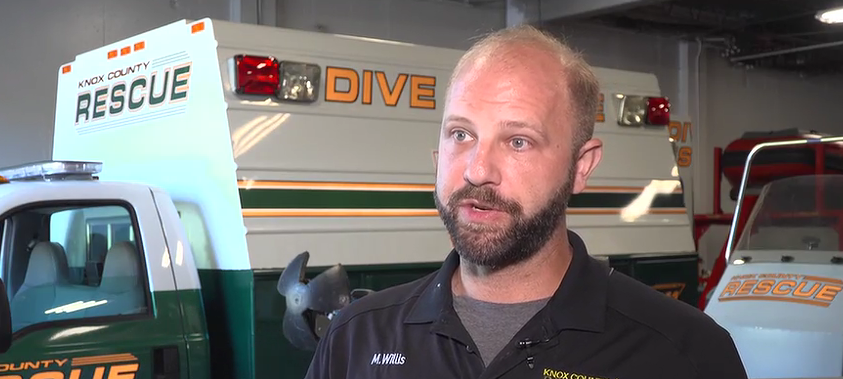
Knoxville, TN (WOKI / WVLT) – As demand for water rescue and recovery services continues to grow across East Tennessee, Knox County Rescue is working to upgrade its equipment with technology that could help locate victims more quickly and safely.
According to members of the rescue squad, the agency’s water team is now responding to calls three to four times per week during the busy water season. To help meet that growing demand, Knox County Rescue hopes to purchase a remotely operated underwater vehicle, commonly known as an ROV, and plans to sell one of its trucks to help fund the purchase.
More Calls, More Recoveries
Knox County Rescue Water Team Captain Matt Willis said the number of water-related incidents requiring a response has increased over the last several years.
“Unfortunately, most of ours are recoveries and not rescues,” Willis said. “But we try to help give closure to the family whose loved one is missing.”
The squad routinely assists local, state and federal agencies in searches involving missing boaters, swimmers and other water emergencies throughout the region.
TWRA Relies on Local Rescue Squads
The Tennessee Wildlife Resources Agency frequently partners with rescue squads during water emergencies.
TWRA spokesperson Matt Cameron said the agency depends heavily on organizations like Knox County Rescue when search and recovery efforts are needed.
“You know, we’re not trained in rescue, not necessarily trained in recovery, but it’s part of the nature of our job. And we do rely heavily on local rescue squads to assist us in doing that,” Cameron said.
Challenging Conditions in Tennessee Waters
Finding a person underwater can be extremely difficult, especially in waterways such as the Tennessee River.
Willis described the river’s visibility as extremely limited.
“It’s not the clearest. Most of the time it looks like you’re swimming through chocolate milk,” he said.
Currently, rescuers rely heavily on sonar technology to search underwater areas. However, Willis said sonar images can be difficult to interpret.
“The screen is split in half with the left and right side,” Willis explained. “A six-foot person is going to be about that big on the screen.”
When sonar identifies a possible target, divers must enter the water and conduct a methodical search pattern to verify what was detected.
New Technology Could Speed Searches
Knox County Rescue hopes an underwater drone could significantly improve those efforts.
The proposed ROV would allow crews to deploy a camera-equipped vehicle directly to sonar coordinates before sending divers into the water.
“With this new ROV, remote operated vehicle, it’ll be on a line and we just kind of chuck it in the water,” Willis said. “We send it down to the GPS coordinates and we can look around and go, ‘Oh yeah, it is or it’s not.'”
The system would provide real-time video from depths exceeding 100 feet, allowing crews to inspect target locations while reducing risk to divers.
According to Willis, some models are also equipped with recovery tools that can assist crews in certain situations.
Safety Remains the Best Prevention
While rescue teams continue improving their capabilities, TWRA officials stress that the best way to avoid a tragedy is prevention.
“Just wearing that life jacket is going to prevent Knox County Rescue from having to use that ROV out there,” Cameron said. “So please wear life jackets. They do make a difference.”
Looking Ahead
Knox County Rescue hopes the new technology will shorten search times, improve safety for divers and provide answers more quickly for families waiting on shore.
For a team that increasingly responds to difficult recovery missions, officials say better equipment means less time searching and more time helping families find closure.